
Take our AI survey
Scientific news has partnered with Trusting News to gather feedback on the potential use of AI in journalism. Currently, we do not publish any content produced by generative AI (see our policy). We want to hear your views on how Scientific news can use AI responsibly. Tell us by taking a short 10-question survey.
The Great Red Spot is the largest vortex in our solar system (SN: 12/12/17). Located in Jupiter’s southern hemisphere, wind gusts exceed 600 kilometers per hour. But it’s not clear how far back in time this place goes and what made it spin.
Fortunately, some past planet observers sketched what they saw through their telescopes. “It was very exciting to see in old articles and books the descriptions of observations and drawings that astronomers made with great precision,” says Agustín Sánchez‐Lavega, an astronomer and planetary scientist at the University of the Basque Country in Bilbao, Spain.
Sánchez‐Lavega and his colleagues dug through the recordings in points. Beginning in 1713, Jupiter reports no sign of the Permanent Place. Then, in 1831 and the following decades, drawings show a spot resembling the Great Red Spot—a clear oval that turned red.
Jupiter over the years
Box Title: For centuries, astronomers have observed Jupiter and its features. In the late 1600s and early 1700s, astronomer Giovanni Domenico Cassini and others observed a dark oval that became known as the Permanent Spot. But beginning in 1713, Jupiter’s reports lacked signs of that place. Then, in 1831, sketches of the gas giant showed a feature at the same latitude – the Great Red Spot. Researchers today have reviewed old images, some shown below, and have concluded that the spots are distinct.
- Astronomer Giovanni Cassini drew this image of Jupiter, showing the Permanent Point, in July 1677. GD Cassini
- This 1711 painting by Donato Creti depicts Jupiter in the night sky. The Permanent Point is colored red, possibly due to information from astronomers who observed the planet. Donato Creti, courtesy Vatican Museums
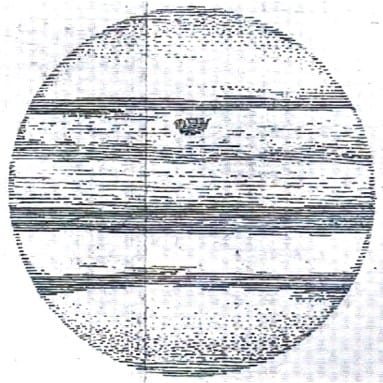
- Some 20 years after it first appeared in drawings of Jupiter, this sketch from May 1851 shows the Great Red Spot as a large oval (outer edge traced in a dotted red line). S. Swabe. Credit: ©UPV-EHU/UPC
- In the first picture of Jupiter, taken in 1879, the Great Red Spot appears as a large dark ellipse. Regular AA. Credit: ©UPV-EHU/UPC
- In this drawing from November 1881, the Great Red Spot is surrounded by a clear oval. This white area, still visible around the Great Red Spot, is called the cavity. TG Elger
- In this color-enhanced photo of Jupiter taken in 1890 at Lick Observatory in California, the Great Red Spot is larger than it is today. Lick Observatory. Credit: BDIP-Observatoire Paris
Measurements of the permanent spot from the drawings suggest it was about one-third to one-half the width of the Great Red Spot as photographed in 1879, which at the time was about three times the width of Earth. The Permanent Spot’s absence from the record for 118 years and its small size suggest it may have disappeared before the Great Red Spot appeared, the researchers conclude.
“That’s very compelling, and they’ve done a really good job,” says Timothy Dowling, a planetary scientist at the University of Louisville in Kentucky.
But it’s still not clear how Jupiter’s iconic storm was born. Sánchez‐Lavega’s team performed computer simulations of Jupiter’s atmosphere to investigate three possibilities: a merger of the swirling regions, the aftermath of a giant storm, or a disturbance between opposing jet streams.
To produce a spot the size of the early Great Red Spot requires the consolidation of vortices that are themselves as large as the red spot was at the time. This is unlikely, the team reports, as such features would have been observed. Meanwhile, simulations of a giant storm failed to produce a spot as large as the early Great Red Spot.
But a gyre could have formed at this latitude between a westward-moving jet stream and an eastward-moving jet stream (SN: 11/3/23). A pressure disturbance could have caused the wind to make a bend at its ends, creating a flow that curved from north to south at one end and from south to north at the other. This rotating region could have acted as a precursor to the Great Red Spot, says Sánchez‐Lavega.
But the simulations used to study the formation of the giant wind storm don’t include storm activity, which is important for how the Great Red Spot is maintained, Dowling says. A ring of storms forms around the planet at this latitude, and eventually the storms are absorbed — and essentially fed — into the Great Red Spot, he says. The Great Red Spot can help spawn these storms—it’s so large that it blocks the flow of gas around the planet at this latitude, creating a low-pressure region ripe for storm formation. “It’s in a global system.”
The Great Red Spot has shrunk since it was first observed in the 1800s. It is currently 1.1 times the size of Earth – about the size of the long-lost permanent dot. And it could share that country’s fate, Dowling says. A shrinking droplet may not be able to feed enough storm activity to sustain itself. “There are some people who are alive now – some younger children – who can see the end of this.”
#Jupiters #Great #Red #Spot #years
Image Source : www.sciencenews.org